Skip to content

Flood Control

Low-footprint, high-volume surface-mounted and submersible Pump Station pumps.

    Build resilience into your stormwater network

    In stormwater planning, pumps are your last line of defense. Rapid response and resilience in the face of extreme environments is critical - whether it's your work site, farm or regional district.

    Prime Fluid Management has partnered with Dutch suppliers Bosman Watermanagement and BBA Pumps to tailor flood protection technology for New Zealand's changing climate. We work with Councils, consultants and civil contractors to deliver solutions that stand up to environmental and economic scrutiny.

    From fish-friendly design to increased resilience and reduced carbon footprint, our goal is to deliver better outcomes with lower impact for New Zealand communities.

    SURFACE-MOUNTED

    BBA High-volume Flood Control Pumps

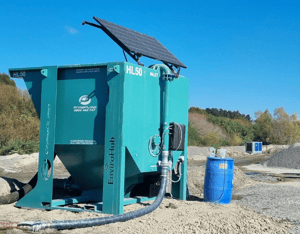
    BBA Pumps is a manufacturer of portable pumps, piping systems and smart logistic solutions. Their BA Series auto-prime pumps span smaller multi-use drainage pumps to large-scale surface-mounted flood control. Even at scale, portability and footprint are key considerations..  

    • centrifugal pump with an axial flow impeller
    • dry self-priming
    • EPA Tier 4 Volvo Penta diesel engine
    • Four-year BBA Limited Factory Warranty
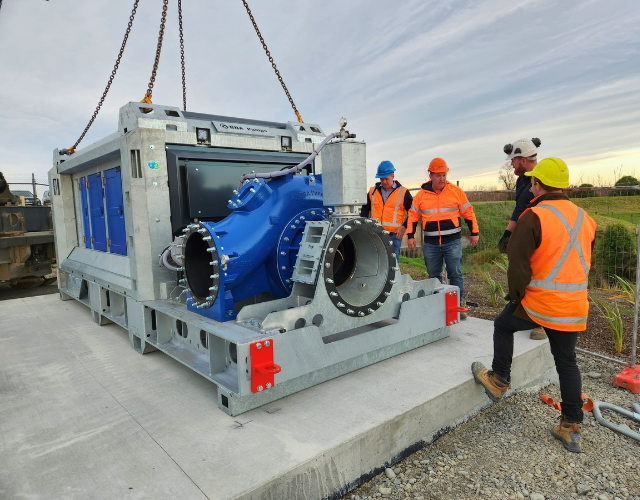
    BBA High-volume Flood Control Pumps
    SUBMERSIBLE

    Fish-friendly by design

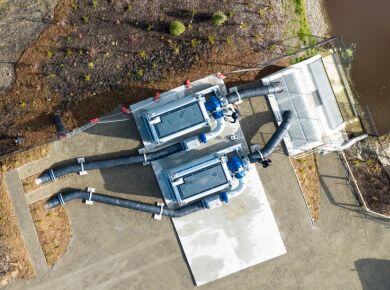
    The Vision Pump is a modular, fish-friendly mixed-flow pump designed to safely transport aquatic life while delivering high-capacity performance in both new and existing pumping stations.

    Key features:

    • Single-blade impeller for reduced fish injury
    • Water-lubricated
    • Capacities from 12 to 360 m³/min
    Fish-friendly by design

    Overview of our Flood Control

    Bosman Vision Series Fish-Friendly Pumps

    The Bosman Vision Series are compact, low noise, low footprint submersible draining and irrigation pumps that perform at range, with limited impact on aquatic life and waterways. 

    • Flow: 12 - 360m3/min
    • Efficiency: up to 85%
    • Fish mortality <2% 
    • Water-lubricated bearings  
    BBA BA400 Relocatable Flood Control Pump

    The BA400 D540 is a relocatable auto-priming centrifugal pump used for flood control or large-scale emergency response. EPA Tier 4 Volvo Penta diesel engine, 85% efficiency at BEP.  Four-year BBA Limited Factory Warranty.

    • Max flow: 3250m3/hr
    • Max head: 25mwc
    • Max solids: 100mm
    • Sound: 65dB @10m
    BBA BA500 Relocatable Drainage Pump

    Producing 37psi and with a favourable NPSHr curve, the BA500g D675 flood control pump will discharge water over long distances through extended pipelines. It is suited to dredging, land reclamation and surface-mounted flood control. Four-year BBA Limited Factory Warranty.

    • Max flow: 4500m3/hr
    • Max head: 26mwc
    • Max solids: 115mm
    • Sound: 75dB @10m
    BBA BA600 Ultra-high Flow Flood Control Pump

    The BA600 D743 is ideal for tackling high water during heavy rain events and flooding. It is quiet and features exterior lighting, lifting features and automatic levelling.  Efficiency is 88% BEP. Four-year BBA limited factory warranty.

    • Max flow: 6,500m3/hr
    • Max head: 31psi
    • Max solids: 135mm
    • Noise: 75bD @10m
    BBA BA700 Ultra-high Flow Flood Control Pumps

    The largest in BBA’s mobile flood control series, the BA700 D810 will shift 7,800m3/hr. Careful attention has been paid to mobility, even at this capacity. Pump efficiency is 85% BEP. Four-year BBA Limited Factory Warranty.

    • Max flow: 6,500m3/hr
    • Max head: 23mwc
    • Max solids: 145mm
    • Noise: 75dB @10m

    Download the Stormwater Product Guide

    See other Industrial Pumps

    Read Industrial Articles

    GALLERY

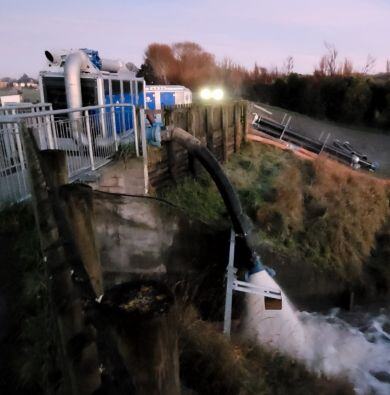
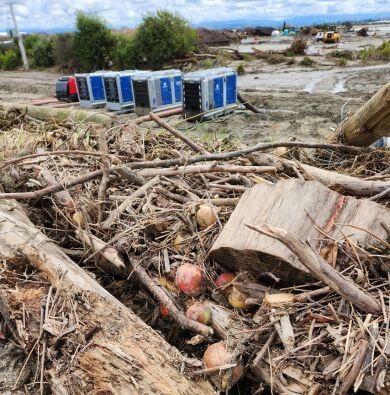
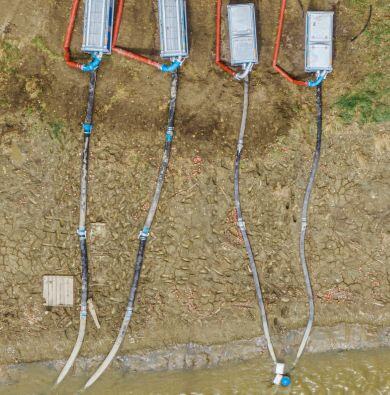
    In the field

    Here are some examples of our solutions being used.
    They brought their mechanics, they didn't just dump it and leave….couldn't have done it without them to be honest

    Mark CadwalladerCatchment Worker

    This sort of unique system you set up is what sets you apart from others in the Market

    Jacob Warmsley Project Manager

    I had an amazing experience with Prime Pump at the Transmission Gully ... will recommend you guys anytime and anywhere.

    Peter FisherDirector

    You guys had our backs from the get-go and stood beside us and persevered.

    DaveOps Director

    We called for a different type of solution…... We were pretty happy with what's been delivered

    Rob KerrProject Director

    Prime supplied us with the best solution for hire and the instant availability was what we needed… We certainly will be using them in the future

    Priscilla EllmersWastewater Supervisor

    Make an enquiry

    Let’s sort your fluid management needs 
    Speak to an expert

    Ricardo Holt

    Ricardo Holt
    Sales Team Leader

    Duncan Moore

    Duncan Moore
    Sales Engineer

    Charlie Petrie

    Charlie Petrie
    Sales Manager

    Questions

    FAQ

    At Prime Fluid Management, we understand that every fluid management challenge brings unique considerations. Here, you’ll find clear, practical answers and expert guidance to help you maximise uptime, achieve regulatory compliance, extend equipment life, and implement the most effective solution for your site.

    Do you supply oil transfer pumps that can meet API 676 requirements?
    Some positive displacement internal gear pump ranges are manufactured to API 676, with specific exceptions depending on the model. If API 676 compliance is part of your specification, we can confirm suitability during selection and provide the relevant documentation.
    What’s the best oil transfer pump in NZ for diesel, fuel oil, or lubricating oil?
    The best option depends on viscosity, temperature, and whether you need steady metered flow or high throughput transfer. For many industrial oils and fuels, internal gear and external gear pumps are common choices because they provide consistent flow and handle higher viscosity fluids well.
    Can these pumps be specified for hazardous areas?
    Yes, hazardous area options may be available depending on the selected pump and motor package. For example, some equipment ranges offer certified IECEx hazardous area rated configurations, which can be specified when the site classification requires it – including suitable options for Zone 1 and Zone 2 hazardous areas.
    Do you need flooded suction, or can the pump run on suction lift and self priming?

    It depends on the fluid, temperature, viscosity, and how the tank and pipework are laid out. A flooded suction setup is usually the most stable option for consistent performance, especially with higher viscosity oils, because the pump is always supplied with product.

    If the pump needs to draw from a lower level or from a longer suction line, suction lift and self priming capability become important. However, the setup needs to be sized correctly to avoid issues like poor priming, air ingress, or cavitation. If you share your suction conditions and duty point, we can recommend a pump type and configuration that suits the installation.

    What features help protect the pump and improve reliability on fuel and oil duties?

    For fuel and oil applications, reliability often comes down to protecting the pump from pressure spikes and contamination, and selecting the right sealing arrangement. Depending on the pump type and duty, options can include an internal relief or bypass valve to protect against dead heading, and an inline suction strainer to reduce the risk of damage from debris.

    Seal selection also matters for demanding services, with configurations such as double mechanical seals used on certain duties where additional containment or reliability is required. We can guide you on what features make sense based on the product, operating conditions, and site requirements.

    What information do you need to specify a fuel transfer pump in NZ?

    To specify the right fuel transfer pump for a New Zealand site, we typically need the fuel type, required flow rate, temperature, and viscosity, along with suction conditions such as flooded suction or suction lift.

    Once we have those details, we can confirm the most suitable pump type and configuration for your application – including options for heavier fuels where viscosity is higher.