/Logo/Prime_logo_web_colour.svg)
/Logo/Prime_logo_web_white.svg)

Most pumping problems don’t start with the pump itself. They start with the fluid.
Oil that’s too thick. Flow that changes as temperature shifts. Chemical dosing that drifts out of spec. Pumps may work fine at startup – then struggle once pressure builds.
This is typically where a gear pump becomes the right tool for the job.
Gear pumps aren’t general-purpose pumps. They’re specified when consistency, accuracy, and reliability matter more than raw flow. Across New Zealand industries, they’re relied on to move fluids that cause problems for other pump types.
At Prime Fluid Management, we see gear pumps used when teams need certainty – not workarounds.
This guide draws on real-world experience from Kobus van der Merwe, Industrial Sales Engineer at Prime, who works closely with customers to specify gear pumps for demanding fluid applications across New Zealand.
Key takeaways – Gear pumps at a glance
- Gear pumps are used when fluid properties create reliability issues for other pumps.
- They provide predictable, positive displacement flow.
- Ideal for high-viscosity, lubricating, or critical fluids.
- Common in waste oil transfer, lubrication, chemical dosing, and industrial processing.
- Correct selection reduces unplanned downtime and operational risk.
When does fluid transfer become difficult?
Fluid transfer becomes hard when changes in temperature, viscosity, or operating pressure cause pumps to lose efficiency or control. Many pumping systems work well – until conditions change.
Common issues before a gear pump is specified include:
- Flow rates changing as fluid temperature rises or falls
- Pumps losing efficiency with thicker oils or other viscous products
- Inconsistent dosing affecting process control or compliance
- Increased wear when pumping shear-sensitive or lubricating fluids.
Our infographic below highlights the conditions where a gear pump becomes the right choice – particularly when fluid properties start to affect reliability or control.
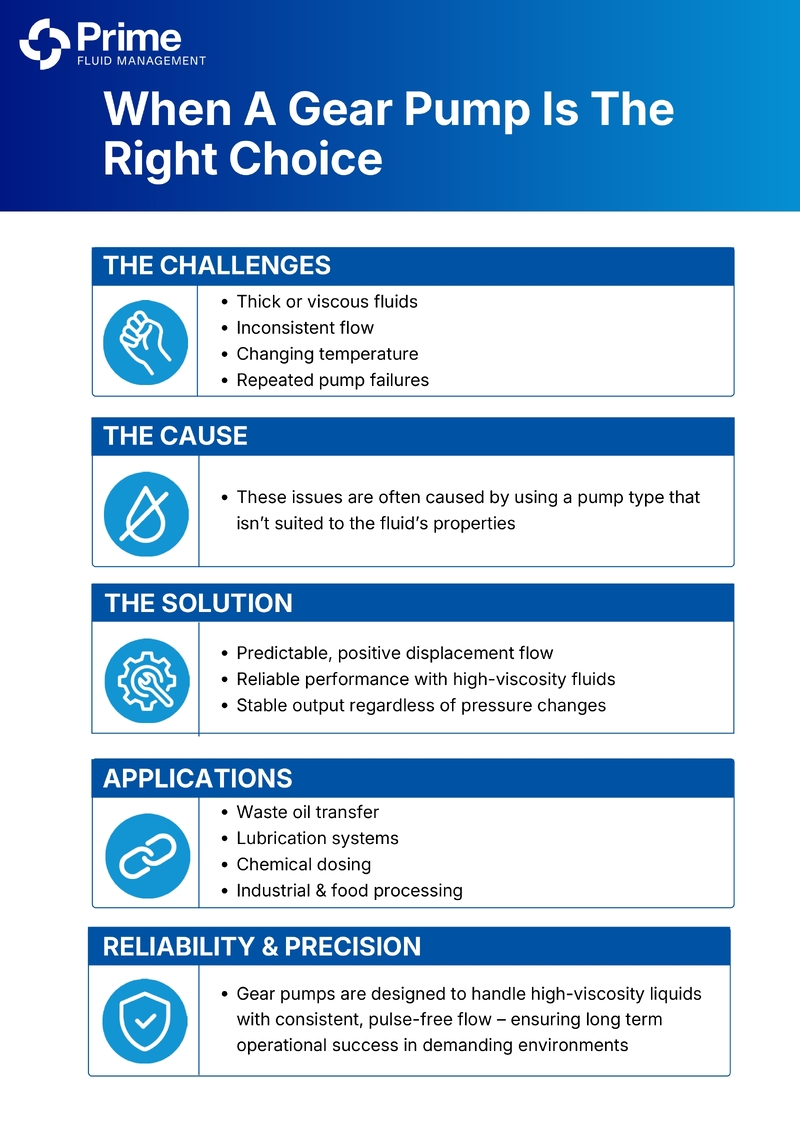
These problems aren’t usually caused by poor installation or operation. They’re caused by using a pump type that isn’t suited to the fluid.
Gear pumps exist specifically to solve these challenges.
What does a gear pump do?
A gear pump moves a fixed volume of fluid with every rotation – delivering consistent, positive displacement flow. Instead of relying on velocity or pressure changes, it physically carries fluid from the inlet to the outlet.
As Kobus explains, this is why gear pumps are typically applied to lubricating fluids rather than water-based products. This positive displacement approach delivers two key outcomes:
- Consistent flow – even as pressure changes
- Reliable performance with high-viscosity fluids.
If the fluid is thick, critical, or needs accurate control, a gear pump will keep doing its job when other pumps start to struggle.
Why are gear pumps suitable for high-viscosity fluids?
Gear pumps are suitable for high-viscosity fluids because they use positive displacement rather than relying on fluid velocity. High-viscosity fluids, such as oil, grease, chocolate, syrup, or waste products, expose the weaknesses of many pump types.
Gear pumps maintain efficiency even when dealing with high-viscosity fluid because:
- Flow remains stable as viscosity changes
- Fluid is positively displaced rather than thrown
- Lubricating fluids actually suit the gear mechanism.
This makes high-viscosity gear pumps a common choice where reliability matters more than speed.
Explore our viscous fluid pumping solutions.
.jpg?width=1200&height=633&name=Blog%20Gear%20Pumps%20%20(2).jpg)
A Varisco industrial gear pump
Where are gear pumps most commonly used?
Gear pumps are often selected for applications involving viscous, critical, or accuracy-driven fluids. But rather than being utilised everywhere, they’re used very deliberately.
Waste oil and used fluid transfer
Waste oil is often thick, contaminated, and temperature-sensitive. A waste oil gear pump provides controlled, reliable transfer without the loss of performance common in centrifugal pumps – making it well suited to handling used oils and difficult fluids across industrial environments.
Find out more about pumping waste oil and difficult fluids.
Chemical dosing and treatment
Gear pumps are widely used where accurate dosing is required. Their fixed displacement supports repeatable flow rates and tighter process control.
See our chemical gear pumps.
Industrial and food processing
From oils and additives to viscous food products, gear pumps support controlled transfer in production environments where quality and reliability are critical.
Across these applications, gear pump efficiency isn’t about headline numbers – it’s about delivering the same result, every time.
Take a look at our food processing gear pumps.
Lubrication systems
In lubrication circuits, consistency matters. Gear pumps deliver predictable flow to bearings, gearboxes, and machinery – reducing wear and improving equipment life. In these applications, an electric gear oil pump or gear oil transfer pump supports stable, repeatable oil supply where fluctuations can cause damage.
View our fuel and oil gear pumps.
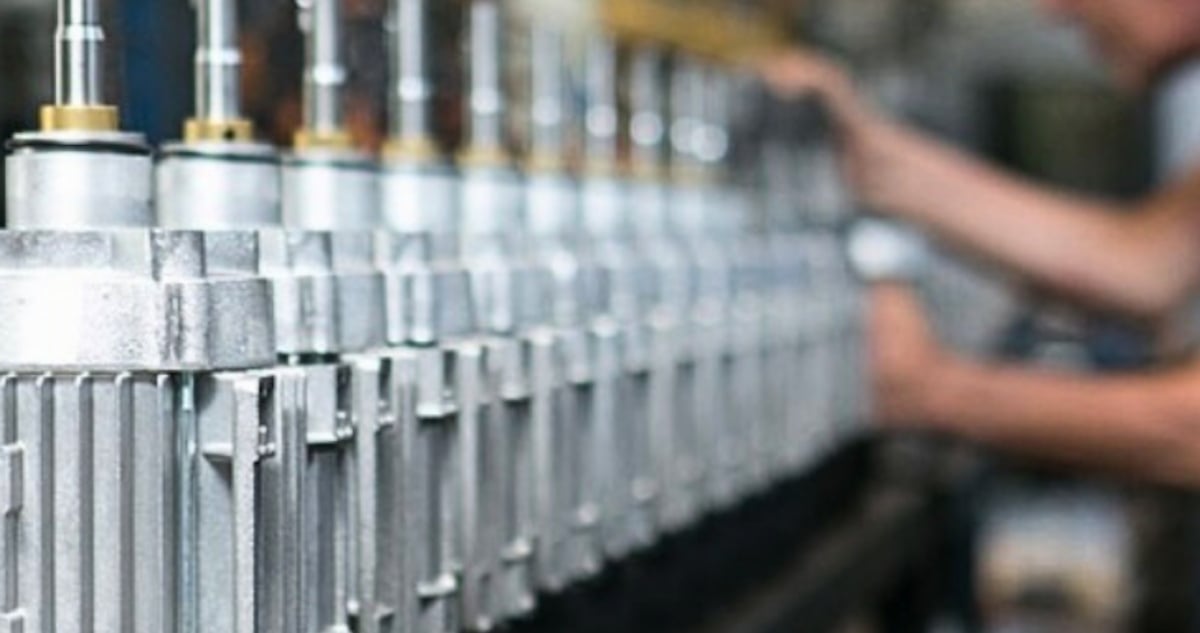
GVR external gear pumps
What are the benefits of using a gear pump?
When specified correctly, gear pumps offer reliable, accurate, and low-maintenance fluid transfer. These benefits translate into measurable operational advantages, such as:
- Reliability – fewer performance issues as conditions change
- Accuracy – stable flow supports process control and compliance
- Low maintenance – simple construction and predictable wear
- Compact design – easier integration into existing systems
- Long term cost efficiency – reduced downtime and rework.
How do you choose between Varisco and GVR gear pumps?
Choosing between Varisco and GVR gear pumps depends on the application, fluid characteristics, and operating conditions. There’s no single best gear pump – selection often involves assessing fluid properties, operating conditions, and system requirements.
In practice, this usually comes down to whether the application prioritises robustness or precision. Some gear pump designs are more tolerant of higher viscosities and minor contamination, while others use tighter clearances to deliver precise, efficient transfer with clean, lubricating fluids.
At Prime Fluid, we guide our customers based on:
- Fluid type and viscosity
- Flow rate and operating pressure
- Chemical compatibility
- Duty cycle and environment.
Varisco gear pumps
Varisco gear pumps are often chosen for tough industrial applications – including waste oil transfer, lubrication systems, and continuous-duty environments where robustness matters.
GVR gear pumps
GVR gear pumps suit precision-driven applications, such as controlled transfer and dosing, where efficiency and compact design are priorities.
Look over our Varisco and GVR gear pump solutions.
.jpg?width=1200&height=633&name=Blog%20Gear%20Pumps%20%20(1).jpg)
Varisco gear pumps
How do you avoid choosing the wrong gear pump?
The fastest way to waste money on a gear pump is to choose one based on size alone. To avoid choosing the wrong gear pump, start by:
- Identifying the fluid being pumped and how its viscosity changes
- Defining the operating temperature range, flow rate, and pressure
- Understanding the duty cycle and expected operating hours.
Kobus notes that viscosity, temperature, and duty cycle are always assessed together – focusing on one without the others is where problems usually begin.
If you’re an engineer or project manager new to gear pumps, be sure to focus on the fluid and the application, not just the pump.
If you’re part of a maintenance team reviewing existing systems, gear pumps often provide an opportunity to stabilise performance and reduce repeat failures caused by viscosity or flow variation.
At Prime Fluid Management, we help NZ businesses select the right gear pump based on how systems actually operate.