/Logo/Prime_logo_web_colour.svg)
/Logo/Prime_logo_web_white.svg)
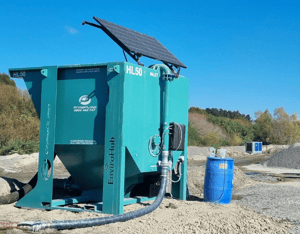


Choosing the right pump usually only gets attention when something goes wrong – loss of prime, rising operational costs, or unexpected downtime.
At Prime Fluid Management, we supply and hire mobile pumping solutions for dewatering, sewer bypass, flood response, and other water management applications across New Zealand.
Among those options, BBA pumps are widely specified in civil construction for their practical design, fuel economy, and ability to keep running in demanding site conditions.
Auto-prime and piston pumps behave very differently under changing inflow and duty-cycle demands. Getting the pump type right reduces risk before performance, efficiency, and operating costs even come into play.
This article outlines how each pump type works, when it’s right for your project, where PTO driven setups fit, and why BBA’s engineering approach makes a practical difference.
It draws on real-world experience from Charlie Petrie, Sales Manager at Prime Fluid Management.
Key takeaways – BBA pumps at a glance
-
Auto-prime pumps suit critical applications where rapid start-up and automatic re-priming are essential.
-
Piston pumps handle variable inflow and challenging groundwater conditions.
-
Self-priming pumps support continuous bypass and steady long-duration duties.
-
PTO-driven configurations make sense where tractor power is already available on site.
-
Selecting the right BBA pump type reduces downtime, fuel use, and avoidable intervention.
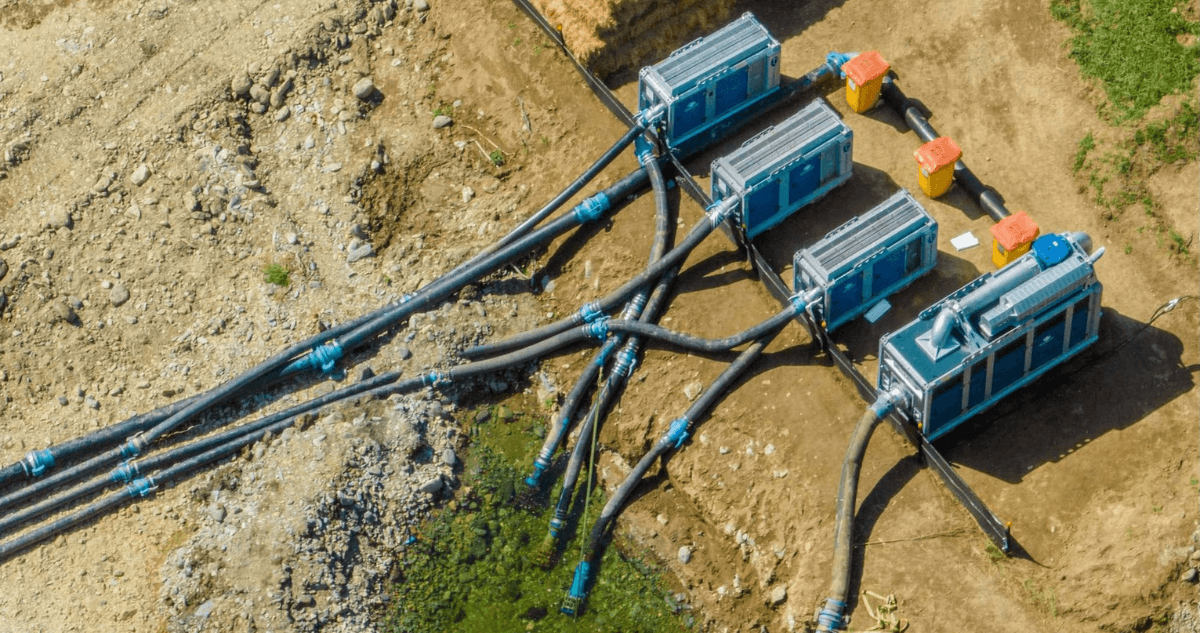
BBA auto-prime pumps overpump the full flow of the Maitai River in Nelson, creating a safe site for flood remediation work to begin.
Why does pump type matter on site?
Pump type matters because site conditions place very different demands on priming, suction reliability, and how a pump behaves when conditions change.
One of the most common challenges we see isn’t selecting the wrong pump size – it’s selecting the wrong type of pump.
Selecting a pump on size alone ignores how it will actually behave on site. The same principle applies to dewatering and bypass pumps – selecting the wrong pump type, even at the right size, often leads to higher operating costs and avoidable downtime.
Using a pump that isn’t suited to fluctuating inflows, high suction lift, or long-duration bypass work can quickly lead to:
- Loss of prime and unplanned shutdowns
- Increased fuel consumption
- Higher maintenance and wear
- Delays during critical weather or tidal events.
In New Zealand, variable groundwater levels, long suction runs, tidal influence, and increasingly intense rainfall place greater demands on pumping systems – making pump type selection especially important.
What makes BBA pump engineering different?
Within our broader mobile pump range, BBA engineers its pumps around how they’re deployed, maintained, and kept running on active sites – not just how they perform in test conditions.
Its design focus extends beyond flow and pressure to include:
- Accessible service design – which simplifies routine maintenance
- Extended service intervals – in some applications up to six times longer between services
- Integrated priming systems – for dependable start-up and air handling
- Efficient operation – that improves fuel consumption and reduces unplanned downtime.
On active sites, these details matter. Faster servicing, fewer stoppages, and reliable priming translate directly into lower operating costs and reduced intervention.
Find out more about BBA pumps.
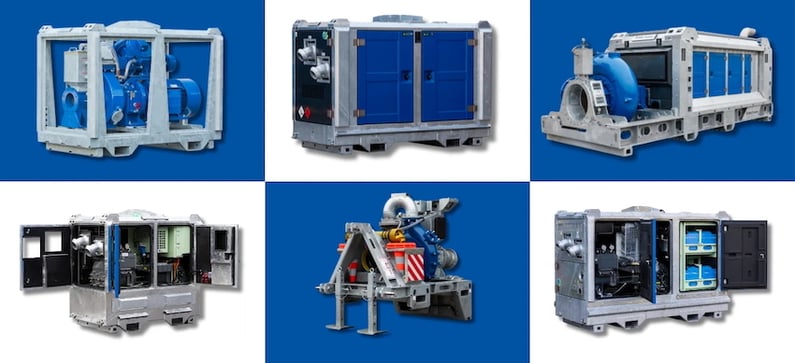
A selection of BBA pump types and configurations used across dewatering, bypass and wellpointing applications.
What BBA pump types are available – and how do you choose between them?
BBA’s pump range includes distinct pump types designed to suit different site conditions – which means selecting the right option comes down to understanding how each type behaves on site.
When is an auto-prime pump the right choice?
Auto-prime pumps are designed for applications where rapid start-up and reliable re priming are critical – such as flood response, sewer bypass, and large-scale dewatering.
Unlike standard centrifugal pumps, auto-prime systems actively remove air from the suction line and automatically re-engage if prime is lost. This allows the pump to start quickly and continue operating when inflow conditions change or air enters the system.
Auto-prime pumps are commonly used for:
- Emergency flood response
- Sewer and stormwater bypass
- Large-scale civil dewatering
- Mining and quarrying operations.
The BA Series of auto-prime pumps from BBA are designed to support dependable, autonomous operation on active sites. Integrated vacuum systems, accessible service design, and extended service intervals help reduce downtime and support lower fuel consumption over long-duration projects.
Discover how the BBA BA150 auto-prime pump outperforms other six inch pumps.
When should you use a piston pump?
Piston pumps are best suited to applications where inflow is variable or suction conditions are challenging – such as wellpointing, deep excavations, and tidal groundwater environments.
Unlike standard centrifugal pumps, piston pumps generate and maintain high vacuum even when inflow is low or inconsistent. This allows them to:
• Stay primed in challenging ground conditions
• Operate without damage during dry-running.
Why select a BBA piston pump?
BBA’s PT Series (piston technology) pumps are built for long-duration wellpointing work, with extended service intervals and DriveOn® technology that help reduce fuel use, maintenance requirements, and on-site intervention.
Learn more about BBA’s efficient PT DriveOn® pump technology.
When does a PTO-driven pump make sense?
PTO-driven pumps make sense where tractor power is already available on site and standalone engines or electrical supply are limited – particularly in rural, agricultural, or remote drainage works.
Driven directly from a tractor, PTO (power take-off) pumps remove the need for a separate engine or generator. This can simplify temporary pumping setups where mobility and existing equipment are priorities.
These pumps are commonly used for:
- Rural drainage and water transfer
- Flood mitigation in agricultural areas
- Temporary overpumping and diversion works.
BBA’s PTO-driven configurations integrate BA or B Series pump technology with robust tractor-powered setups – combining dependable pumping performance with simplified deployment. They’re practical, mobile solutions that reduce equipment complexity on site.
See how PTO-driven BBA pumps have been used for flood response in NZ.
When are self-priming pumps the right choice?
Self-priming centrifugal pumps are commonly used in continuous bypass and steady transfer applications where inflow conditions are relatively stable and uninterrupted operation is required.
Once primed, they can re-establish prime without manual intervention – making them well suited to long-duration duties where the primary objective is consistent flow rather than rapid redeployment.
Self-priming pumps are typically used for:
- Continuous sewer and stormwater bypass
- Temporary transfer and diversion works.
At Prime, we typically deploy Varisco self-priming pumps rather than BBA ones for these applications. Varisco’s robust construction and suitability for continuous bypass make them a strong fit where steady inflow and predictable duty cycles are expected.
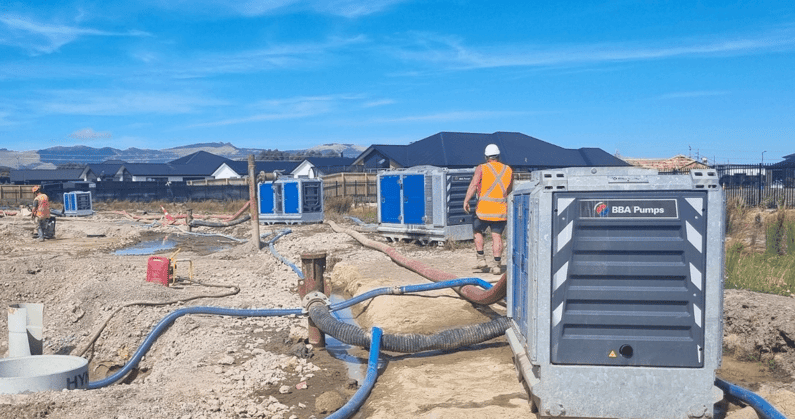
BBA auto-prime pumps managing groundwater during subdivision development works
How to finalise your BBA pump selection
Final pump selection comes down to matching pump behaviour to site conditions, rather than relying on size or headline performance figures alone.
Pump type is usually determined by:
- Inflow behaviour – variable inflow often points to piston technology
- Priming reliability – critical applications benefit from auto-prime systems
- Duty cycle – continuous bypass work suits self-priming pumps
- Site constraints – remote or rural sites may favour PTO-driven pumps.
Once the pump type is confirmed, broader application and lifecycle factors influence long term performance and operating cost.
What to Consider When Selecting a BBA Pump |
|
|
Consideration |
What BBA delivers |
| Deployment environment |
Surface-mounted mobile units built for rapid setup |
|
Service frequency |
Extended intervals that reduce stoppages |
|
Fuel efficiency |
Lower fuel consumption in long-duration applications |
|
Maintenance access |
Practical and accessible service design |
|
Power availability |
Engine, electric, hybrid or PTO configurations |
|
Long term reliability |
Proven engineering backed by decades of development |
Evaluating both application requirements and lifecycle factors helps ensure your chosen pump performs reliably from deployment through to project completion.
Selecting between auto-prime, piston, PTO-driven, and self-priming pumps isn’t about brand preference – it’s about matching pump behaviour and power availability to site conditions.
BBA’s range of pumps is designed around these differences, making selection clearer and more predictable. When pump behaviour aligns with site demands, projects run more smoothly, operating costs stay controlled, and intervention is minimised.
At Prime Fluid Management, we help contractors and engineers align the right BBA pump type with each project’s site conditions – reducing risk before the pump is even deployed.