/Logo/Prime_logo_web_colour.svg)
/Logo/Prime_logo_web_white.svg)

.png?width=300&name=PFM%20-%20Blog%20images%20(1).png)
Prime now offers Graco diaphragm pumps for industrial and process applications where fluid characteristics or operating conditions make pump selection more demanding.
Corrosive chemicals, viscous products, suspended solids and intermittent fluid supply can contribute to wear, clogging, compatibility issues or unreliable flow when the pump is poorly matched to the duty.
Graco’s Husky, QUANTM and SaniForce ranges give engineers air-operated and electric diaphragm pump options, including hygienic configurations – for different fluid, process and site requirements.
This blog explains where each range fits and the sizing tools, product information and manufacturer backing available through Graco. It also highlights the local selection, servicing and parts support available through Prime in New Zealand.
Key takeaways
- Prime now offers Graco air-operated and electric diaphragm pumps, including hygienic options, in New Zealand.
- Graco diaphragm pumps may be useful where chemical compatibility, viscosity, solids, intermittent fluid supply or flow control influence the pump selection.
- Husky, QUANTM and SaniForce give Prime distinct diaphragm pump options across different drive, fluid and process requirements.
- Graco’s sizing tools, product information and regional expertise help inform pump selection and ongoing support.
- Prime adds local pump advice, servicing and parts assistance.
When should you consider Graco diaphragm pumps?
Graco diaphragm pumps may be worth investigating when the fluid, operating conditions or current pump arrangement are creating issues, such as:
- Chemical compatibility – material selection becomes critical
- Viscous or shear-sensitive products – pump choice affects how the fluid is handled
- Suspended solids – clogging or wear is a recurring issue
- Intermittent supply or dry-running risk – inconsistent feed affects reliability
- Flow control or energy use – an electric diaphragm pump may offer advantages over an air-operated option.
None of these issues automatically point to a diaphragm pump. They’re reasons to reassess the pump technology, materials and configuration – and whether diaphragm technology may be a better fit.
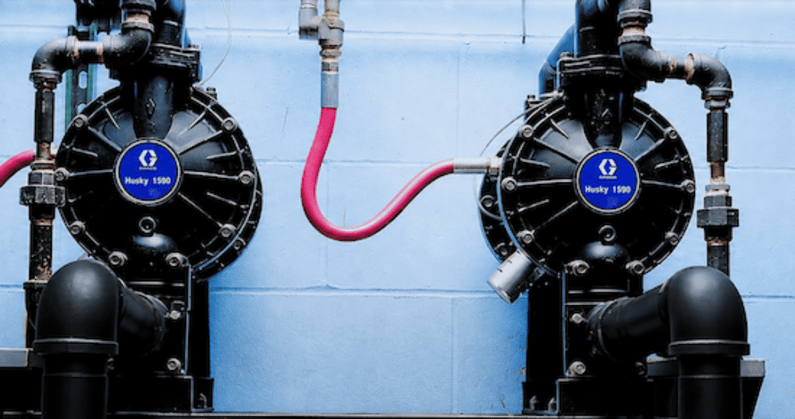
Two Graco Husky 1590 air-operated diaphragm pumps in service.
Which Graco diaphragm pump fits the duty?
Graco’s diaphragm pump range covers different drive types and process requirements – with the best fit depending on the fluid, duty and site utilities.
Husky air-operated double diaphragm pump (AODD)
Using compressed air, the Husky AODD pump suits industrial duties involving chemicals, viscous fluids and suspended solids. It’s a practical option when dry-run tolerance and operating flexibility are important and an air supply is already available.
QUANTM electric double diaphragm pump (EODD)
Driven by electricity rather than compressed air, the QUANTM EODD pump is relevant where energy efficiency, adjustable flow control or process automation are higher priorities.
SaniForce hygienic diaphragm pump
The SaniForce hygienic range is available in air-operated (AODD) and electric (EODD) configurations for food, beverage, pharmaceutical and other hygienic processes. Drive selection can be matched to available site utilities, energy efficiency objectives and process control requirements.
Across Graco’s industrial and hygienic diaphragm pump ranges, selection can be based on fluid characteristics, operating duty, control requirements and available site utilities.
Find out more about Graco diaphragm pumps.
.png?width=795&height=419&name=2_Graco_quantm_electric_double_diaphragm_pumps%20(2).png)
Graco’s range of stainless steel QUANTM electric double diaphragm pumps.
What does Graco bring beyond the pump?
Graco backs its diaphragm pump range with sizing tools, product documentation and access to application and engineering expertise. Prime adds local pump selection, servicing and parts support – giving New Zealand customers a direct route to practical advice and manufacturer input when required.
For customers, that means clearer pump selection, faster access to answers and easier parts identification – with local servicing available through Prime.
.png?width=795&height=419&name=3_Graco_quantm_electric_diaphragm_pump_control%20(1).png)
Graco QUANTM electric diaphragm pump control unit.
Assessing pump options for an industrial or wastewater system? Talk to our industrial pump specialists – they can help you assess the duty and identify your options.