/Logo/Prime_logo_web_colour.svg)
/Logo/Prime_logo_web_white.svg)

What recurring pump problems across a wastewater treatment plant can reveal about hydraulic fit, pump type and installation.
A pump can deliver the required flow and head and still be wrong for the application.
The mismatch often shows up in how the pump behaves. Symptoms may include repeated ragging at the inlet, unstable operation, pump cavitation, increasing motor load as sludge thickens, inconsistent feed into dewatering equipment, or persistent priming and access problems later in the process.
These aren’t always capacity problems. They can indicate that the pump hydraulics, operating range or installation arrangement don’t match what’s actually being moved.
This article follows the treatment process from inlet works to final water transfer. It focuses on where common pump problems surface, what they can reveal, why like-for-like replacement may not fix them, and when a different hydraulic design, pump type or installation is required.
Key takeaways – Wastewater pump selection at a glance
- A pump can meet the required flow and head and still be wrong if its hydraulics, operating range, drive sizing or installation don’t match the media
- Repeated ragging, unstable transfer, rising motor load, uneven dewatering feed and priming problems point to different selection mismatches
- Increasing capacity or replacing a like-for-like pump can reproduce the same problem when the underlying cause remains
- Screw centrifugal hydraulics can suit several relatively fluid duties, but the pump configuration and selection basis change at each stage
- As solids concentration and viscosity increase, progressive cavity pumping becomes the stronger option for controlled dewatering feed
- Final water transfer depends more heavily on suction conditions, access and plant layout than solids handling.
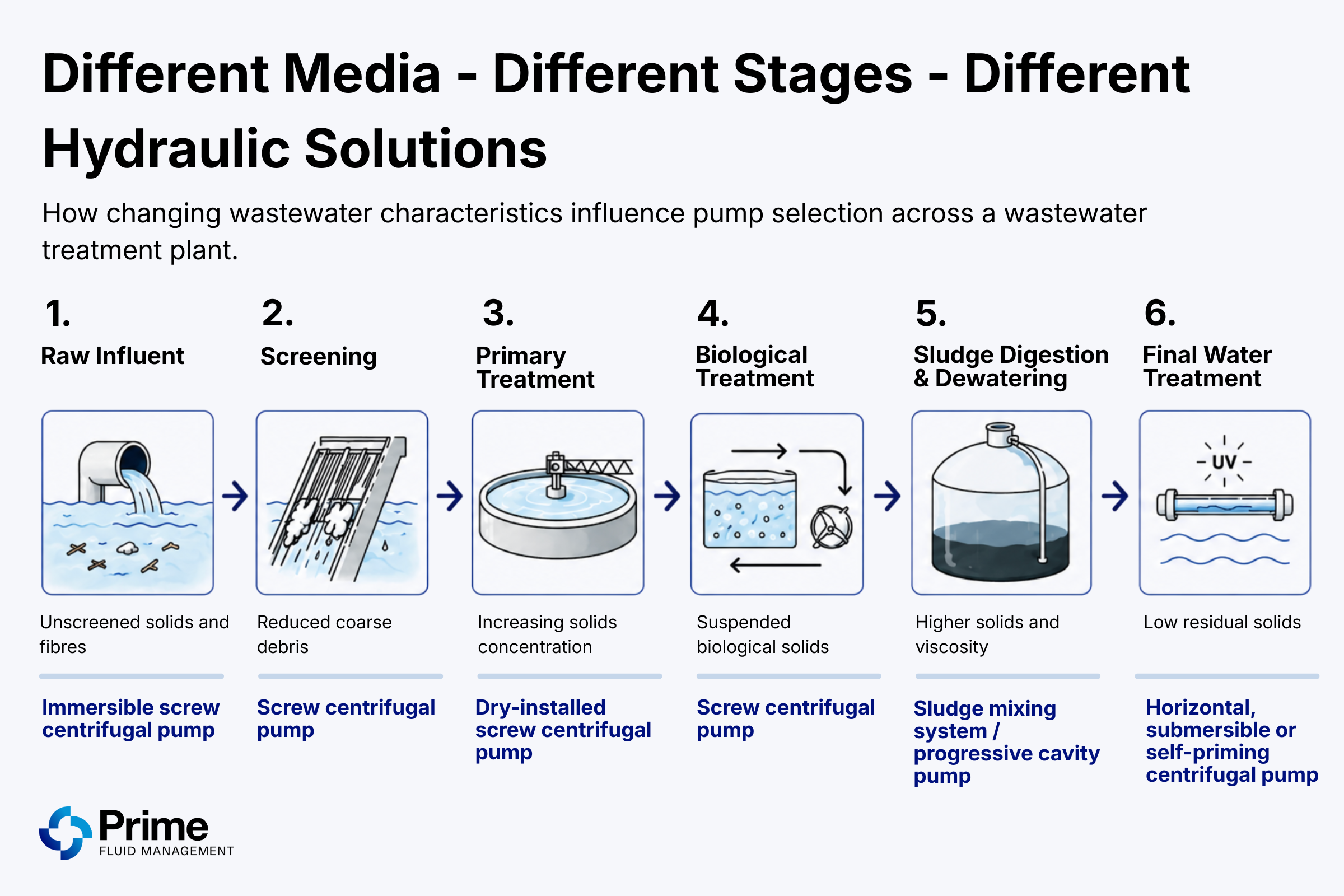
Raw influent – when repeated ragging points to the hydraulics
If an inlet pump repeatedly blocks or needs de-ragging, insufficient capacity isn’t always the cause. It can still deliver the required flow and head while handling solids and fibrous material poorly.
Raw influent combines irregular solids, wipes, textiles and rapidly changing flows. In a pump with restrictive passages or multiple catch points, fibrous material can collect around the impeller and gradually reduce performance. Increasing the pump size or replacing it with a comparable pump may add capacity without addressing why the blockage keeps returning.
One hydraulic design that reduces these catch points is the screw centrifugal impeller. Its single, open passage moves solids and fibres progressively through the pump, reducing the opportunity for material to collect around the impeller.
The benefit isn’t just greater solids-handling capacity – it’s a lower tendency for incoming material to become a recurring maintenance problem.
Find out how Hidrostal’s screw centrifugal impeller works.
.png?width=795&height=419&name=1_Hidrostal_municipal_wastewater_pumping_station%20(1).png)
Hidrostal immersible screw impeller pumps are commonly used in wastewater network pump stations and inlet works.
Post-screen transfer – when unstable flow points to the pump hydraulics
With most of the coarse rag and debris removed during screening, the downstream pumping priority shifts to maintaining consistent transfer into primary treatment.
If flow remains unstable or the pump still requires frequent clearing, residual fibres and solids may be:
- Catching around the impeller
- Collecting within restrictive passages.
Increasing pump capacity may improve performance temporarily without resolving why fibres and solids continue to collect.
At this stage, several pump types can meet the required flow and head. However, designs with more restrictive internal passages can still give residual fibres and solids places to collect.
A screw centrifugal impeller provides a more open hydraulic passage – helping the remaining material move through the pump with fewer catch points. This supports more consistent transfer into primary treatment and reduces the need for operator intervention.
Learn about our Hidrostal wastewater pumps.
Primary treatment – rising load points to more than flow rate
If a primary sludge pump struggles to maintain performance as solids concentration changes, the specified flow rate tells only part of the story. Higher solids content can increase the load on the pump and the power needed to maintain the duty.
That’s why two primary sludge duties with similar flow rates can still call for different pump selections. Replacing the pump like-for-like, or increasing its capacity, may not resolve the problem if the original hydraulic selection and motor sizing didn’t allow for the sludge characteristics or expected operating range.
A dry-installed screw centrifugal pump in a bearing-frame arrangement can address these demands. Its open, single-channel hydraulic passage provides a less restrictive path for the sludge – while the pump and drive can be configured for the expected solids load and operating range.
Read about how Hidrostal pumps are configured around site conditions.
.png)
Biological treatment – unreliable return flow threatens biomass health and process stability
If return sludge flow becomes inconsistent or is interrupted, the effect can appear in the biological process before it looks like a conventional pump problem. The return loop must keep settled biomass moving back to the aeration tank – while excess sludge is withdrawn to control the amount of active biomass.
A pump may meet the nominal flow and head yet still struggle across the required return range. The issue is therefore not simply capacity, but whether the pump can maintain dependable recirculation across the required operating range.
Return and excess sludge are still relatively fluid, so several pump types can be considered. Some conventional centrifugal designs have more restrictive passages where suspended solids can collect – while progressive cavity pumps are generally better suited once the sludge becomes thicker and controlled feed is required.
For continuous return-sludge recirculation, a screw centrifugal impeller provides a more open solids passage while retaining the flow characteristics needed across the operating range.
That doesn’t mean the same pump configuration is carried unchanged throughout the plant. The design priorities differ depending on whether it’s used:
- At the inlet – where rag and irregular solids are the main concern
- In primary treatment – where higher solids load and power demand become more important
- For biological treatment – where dependable recirculation across the required return-sludge range is the priority.
A screw centrifugal pump selected specifically for this duty combines an open passage for suspended solids with sizing and an operating range matched to continuous recirculation. The pump type may be familiar, but its configuration and selection basis are specific to the return-sludge duty.
Take a look at our Hidrostal screw centrifugal impeller pumps.
Sludge digestion and dewatering – viscosity changes the pump duty
By this point in the treatment process, the media has thickened considerably and transfer can become less consistent. Rising motor load or an uneven feed to dewatering equipment can indicate that the pump is operating beyond the conditions it was selected for.
Here, solids concentration and viscosity become as important as flow and head. As the material thickens, resistance increases and the pump has to work harder to keep it moving. Selecting another centrifugal pump on the same basis can reproduce the same instability if the hydraulics are still better suited to relatively fluid sludge.
During digestion, the immediate challenge is to keep solids from settling and maintain an even tank contents. That usually calls for dedicated mixing equipment or pump-based recirculation.
When sludge is transferred to dewatering equipment, the operating problem changes again. The pump is no longer just circulating sludge – it must deliver a controlled, consistent feed of more concentrated material into centrifuges, filter presses or screw presses.
A progressive cavity pump is better suited to that job because its positive displacement action provides a steady, low-pulsation flow.
The change in pump type follows the change in how the sludge behaves and what the process now needs from the pump – not simply a requirement for more capacity.
Discover our Hidrostal sludge mixing solution and Wangen progressive cavity pumps.
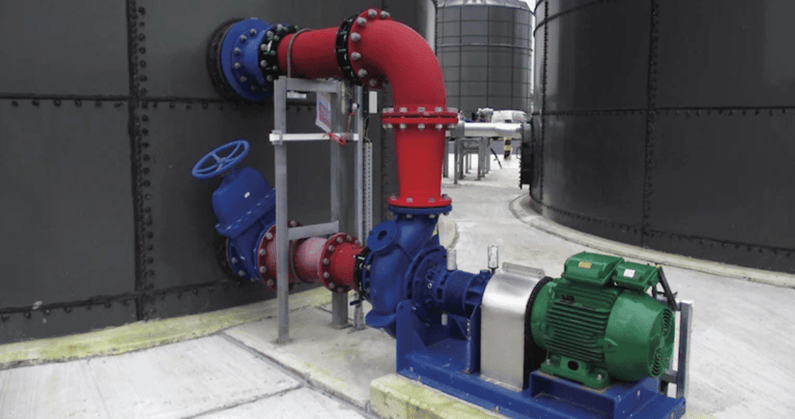
Hidrostal HidroMix systems maintain sludge circulation during the digestion process.
Final water treatment – cleaner water can expose installation problems
If a pump is difficult to prime, awkward to access or operates inefficiently, the issue may lie less with the water and more with how the pump is installed.
By this stage, solids handling is no longer the main selection priority. Suction conditions, pump location and maintenance access become more important. Replacing the pump without reconsidering how it’s installed can preserve the same priming, access or efficiency problems.
The pump choice depends on the site layout and how the water needs to be moved. A dry-installed horizontal centrifugal pump works well where favourable suction conditions and straightforward surface access are available.
A vertically mounted submersible pump suits an in-wet well installation – while an above-ground self-priming pump fits installations where the water source sits below the pump and surface-level access is preferred.
The solution isn’t necessarily a different hydraulic principle. It’s a pump configuration matched to the final duty, suction conditions and plant layout.
Find out about our Varisco self-priming pumps.
Looking at the whole plant
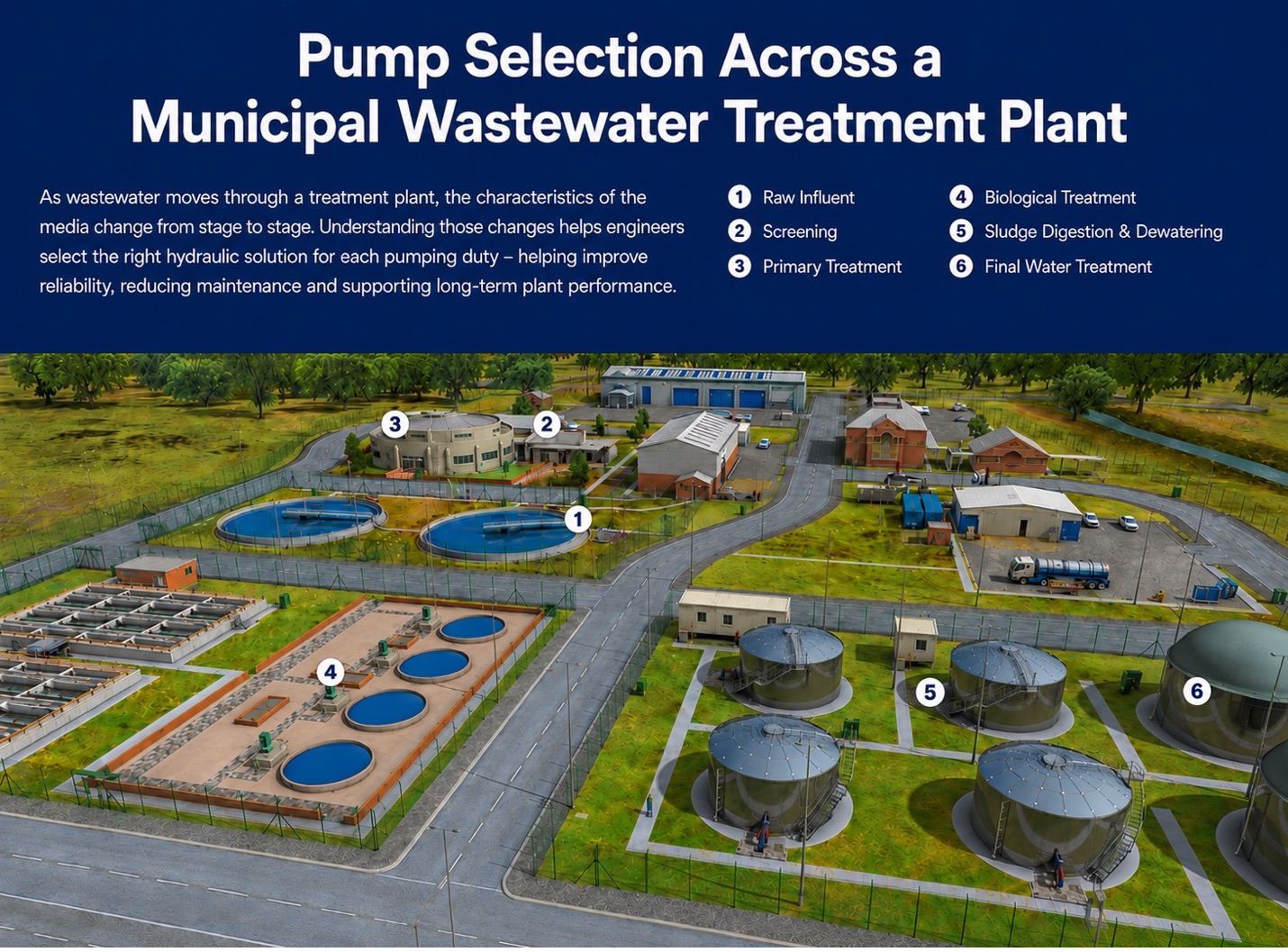
Recurring pump problems often reveal more than a lack of capacity. The mismatch may show up as:
- Ragging at the inlet
- Unstable transfer after screening
- Rising load as solids increase
- Uneven feed into dewatering equipment
- Persistent priming or access problems.
Each symptom points to a different issue within the original pump selection.
Flow and head establish the duty point, but the pump choice also needs to account for the material, operating range, hydraulic design, drive sizing and installation. Replacing a pump like-for-like or simply increasing its capacity can reproduce the same problem when one of these factors has been overlooked.
The same broad pump technology can appear at several stages, but the configuration and selection priorities change with each duty. As the material becomes thicker and more viscous, a different pump type often becomes necessary.
Later in the process, site layout and suction conditions can carry more weight than solids handling.
Looking at how a pump behaves in service helps identify what the original selection missed. The aim isn’t to standardise one pump across the plant – it’s to match each duty with the hydraulic design, operating range and installation that directly address the recurring problem.
Check out all our wastewater treatment plant solutions.